Custom Diamond Painting Size Guide: How Big Should You Go?
Turning a favorite photograph or original piece of art into a custom diamond painting is an incredible feeling. You order the kit, unroll the canvas, and prepare to watch your memory come to life one sparkling drill at a time. Then comes the moment of truth. You stick down the final diamond, step back, and... instead of a clear portrait of your beloved dog, you are staring at a blurry, unrecognizable blob of brown and orange.
What went wrong? Nine times out of ten, the issue isn't the craft itself—it’s the dimensions. Selecting the best canvas size custom diamond painting option is the single most critical decision you will make when ordering a custom kit. Here is everything you need to know about sizing to ensure your project turns out crisp, clear, and display-worthy.
The "Pixel" Problem: Understanding Diamond Math
To pick the perfect canvas size, it helps to understand how diamond painting works on a structural level. Think of diamond drills as physical pixels:
- Every drill takes up fixed space: Standard round and square resin drills measure approximately 2.5 millimeters (0.25 cm) across.
- Dimensions equal resolution: On a 30 x 40 cm canvas, you only have 120 drills horizontally and 160 drills vertically (19,200 total) to represent your entire photograph.
- Details become diamond symbols: Squeezing a complex scene with multiple people into a small grid forces the canvas to simplify details. Eyes can turn into single black dots, and smiles can become jagged lines.
- Larger canvases preserve visual information: A larger grid gives our design team more placement spaces to render subtle shading, distinct facial features, fur textures, and smooth color transitions.
The Four Main Factors That Determine Your Size
1. Number of People or Subjects
As the number of important subjects increases, your canvas size must increase to match:
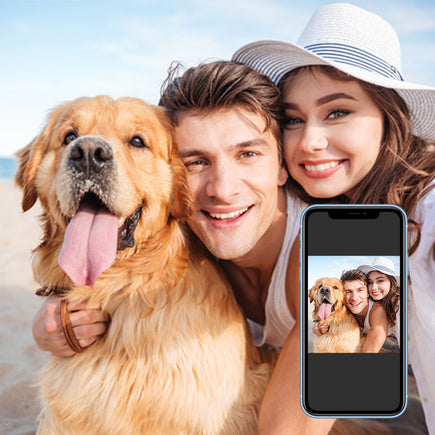
- One Subject: A moderate size (30x40 cm) is usually enough when a single face or pet fills most of the frame.
- Two Subjects: Allow extra space (40x60 cm) so facial features and outlines remain distinctly separate.
- Three or Four Subjects: Opt for a larger canvas (60x80 cm) so features don't blur together at a distance.
- Large Groups (5+ People): Choose an extra-large canvas (80x80 cm) option so every face remains recognizable.

2. Subject Distance and Cropping
A close-up image requires far less canvas space than a full-body or distant photo. A tight shot of a dog’s head needs less space than a pet sitting far away across a backyard.
Pro Tip: Before uploading, check if your main subject fills the frame. Removing unnecessary background areas (like wide expanses of sky, flooring, or walls) gives the design grid more room to preserve the essential details.
3. Image Detail and Background Complexity
A single portrait against a plain wall translates easily at moderate scales. However, you should choose a larger canvas if your photo includes:
- Full-Body Portraits: Photographs showing subjects from head to toe (rather than a tight close-up) need extra canvas space to capture posture and clothing details alongside facial features.
- Detailed Clothing & Attire: Images featuring intricate lace, detailed wedding dresses, or textured patterns on clothing require more drills to render clearly.
- Intricate Pet Fur & Markings: Photos of pets with complex fur patterns, subtle shading, or specific distinct markings require medium-to-large canvases to prevent those details from muddying into flat colors.
- Detailed Backgrounds & Scenery: Photographs surrounded by floral arrangements, cityscapes, architectural lines, mountains, or fine foliage need a larger or wide format to preserve background depth and detail.
4. Aspect Ratio and Photo Orientation
Always match your custom canvas dimensions to the natural aspect ratio and proportions of your original photo:
- Square (1:1): Works best for close-ups, single pets, and centered compositions (e.g., 40x40 cm, 50x50 cm).
- Portrait (4:3 or 3:2): Ideal for individual people, couples, and full-body shots (e.g., 30x40 cm, 40x50 cm, 60x80 cm).
- Landscape / Panoramic (16:9): Best for family groups, wedding parties, travel memories, and scenery.
- Automated Orientation: When you upload a horizontal image, our design team automatically adjusts the canvas orientation to match your photo's natural flow—no manual editing required on your end!
Think About Where You Will Display It
The finished artwork should suit the room in which it will be displayed. Smaller canvases work well on compact walls, shelves, or desks. Medium-sized pieces are ideal for bedrooms, hallways, offices, and reading corners. Larger custom diamond paintings make striking statement artwork above a sofa, bed, sideboard, or fireplace.
Pro Tip: The dimensions specified for Diamond Painting Pro products refer to the printed design area. Before ordering, outline the selected width and height on your wall using removable tape or paper to visualize how much visual space the artwork will occupy.

Balance Size with Completion Time and Workspace
While a larger canvas preserves more detail, it requires more drills and time. Before picking your dimensions, consider your available crafting time, table space, storage area, gift deadlines, budget, and experience level. Smaller projects are approachable for beginners, while larger canvases are ideal for crafters seeking a detailed, long-term project.
What Happens If the Selected Size Is Not Suitable?
After your order is placed, our design team will review and optimize the uploaded image for custom diamond painting. This process may include adjusting the composition, preparing the image for the selected dimensions, and ensuring that the most important features are represented as clearly as possible.
If a significant change is required—such as selecting a different size to better suit the image—we will notify you by email before proceeding. Our team will review the design and contact you when an important adjustment is recommended.
How Big Should You Go?
When deciding on custom diamond painting dimensions, the baseline rule is simple: Size up whenever your budget and workspace allow. Finding the best canvas size custom diamond painting option ensures your hours of hard work pay off with a stunning, high-definition piece of art. Choosing the right diamond painting size for photos with complex details or multiple subjects guarantees every facial feature and background accent renders perfectly.
Select your dimensions, upload a meaningful photo, and begin transforming your favorite memory into sparkling personalized art!
FAQs
1. Why do small custom diamond paintings look blurry?
Diamond drills act as physical pixels measuring about 2.5 mm each. A small canvas (like 25x25 cm) lacks the physical space and drill capacity needed to capture fine details, resulting in a pixelated appearance.
2. What is the most popular size for a custom diamond painting?
The 40x50 cm canvas is the most popular choice. It strikes an ideal balance between price, completion time, and visual resolution—offering enough clarity to make single pets or one-to-two-person portraits look sharp.
3. Do square drills or round drills require different canvas sizes?
No, both drill types cover roughly the same surface area (2.5 mm each), so sizing guidelines remain identical. However, square drills fit together edge-to-edge without small gaps, making fine details look slightly sharper on medium canvases.
4. What size should I choose for a photo with 4 or more people?
For group photos with 4 or more subjects, select at least a 60x80 cm canvas. On smaller sizes, individual facial features will blend together and make people difficult to recognize.
5. Will my photo be cropped if I pick the wrong canvas size?
Yes. If the photo's aspect ratio does not match the canvas dimensions (such as placing a vertical portrait on a square canvas), our design team will crop the image appropriately or email you to adjust the canvas dimensions.